Star of Bethlehem in the Garden
This time of year I feel almost giddy from an inner propulsion to go outside and work in the garden, whether or not the weather allows me to be outside, and whether or not there is any gardening to be done. Of course, always, always, some kind of gardening is waiting for me.
Here, in our place where we have now lived for one year, the whole back yard and the once-upon-a-long-time-ago flower garden along the back fence are totally overgrown by Star of Bethlehem. A search on the internet gave me the Latin name of this stuff - ornithogalum umbellatum - and tells me it is very invasive, as if I needed to be told that. I suddenly realized the short form of Star of Bethlehem is SOB - how appropriate! The only way to get rid of these SOBs is to dig them up and throw out the clumps of bulbs and growth.
The biggest clumps are about a foot across.
During the rainy week that was, any time we had a bit of a break from the rain, I began digging out the clumps of SOBs. The big problem is that the clumps include babies, tiny bulblets deep in the soil, smaller than green garden peas. It is impossible to find all these babies, which means they will grow wherever they happen to be.
I must work at digging for short periods, ideally no more than half an hour at a time, because my knee joints are worn and become too uncomfortable with such jobs as digging, so after each stint I do my stretching exercises. I’ve long known that I can accomplish a lot by working a little at a time. I love this digging, and am enjoying the way the dark friable soil yields to my garden fork.
Andrea, my garden helper, is at the ready to help me as soon as there’s an evening or weekend without rain. Meanwhile I can’t resist the call of the garden fork and the SOBs, and I enjoy seeing the expanding clear space, which will be ideal for hostas to grow among the great rocks that people placed there a long time ago. I thank them for the rocks.
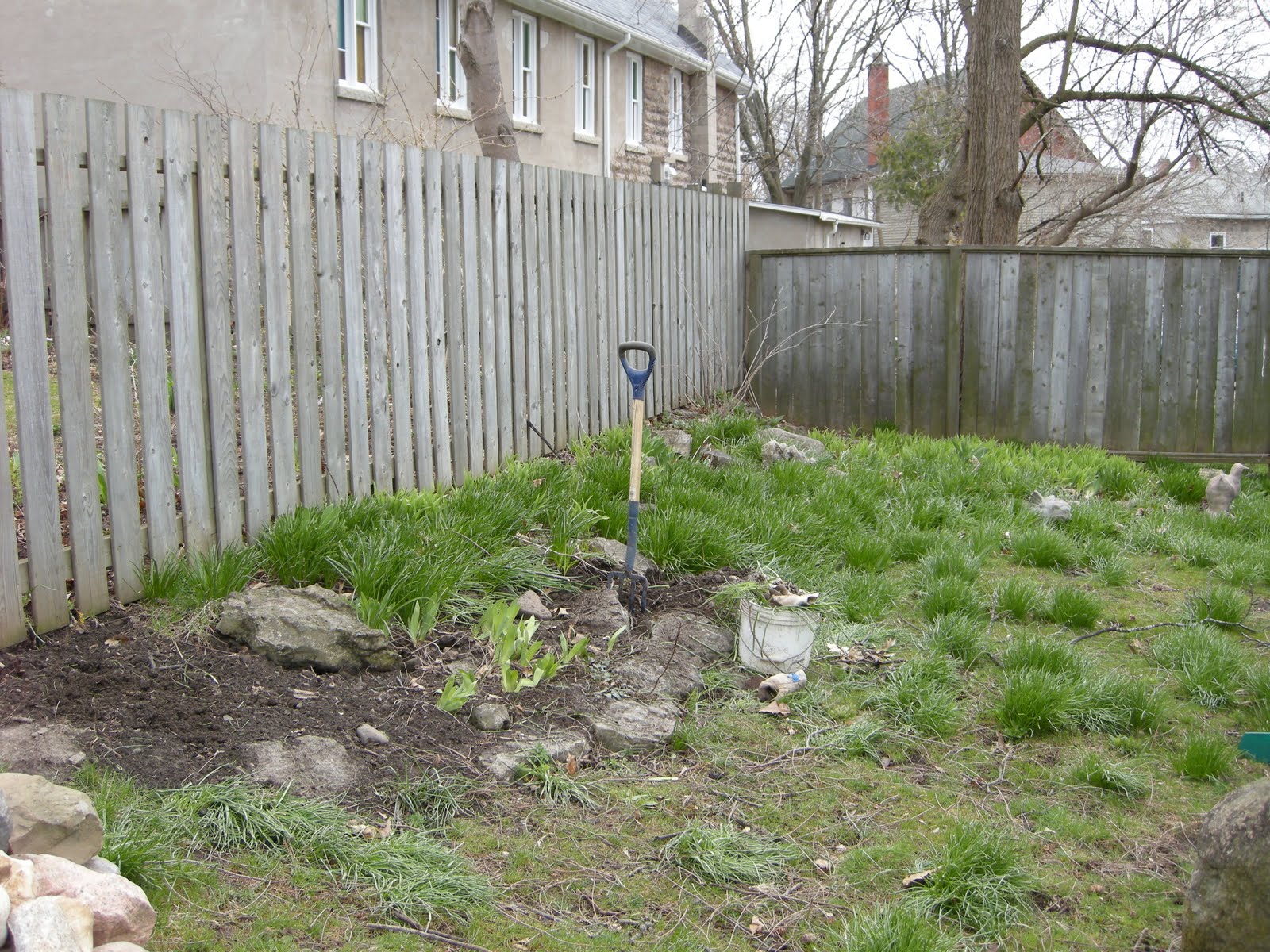
A bit of clear space!
A WORD OF ADVICE. DON'T BE SEDUCED BY THE LOVELY WHITE STAR-SHAPED BLOSSOMS THESE BULBS YIELD. IF YOU PLANT THEM ANYWHERE, THEY WILL INVADE AND TAKE OVER EVERY INCH OF YOUR SOIL!
Monday, April 25, 2011
Thursday, April 14, 2011
ON WORDS AND IMAGES
As someone who draws inspiration and nourishment from both good writing and visual art, I registered for “A Unique Book Club: Words and Images” in the Continuing Studies program at the University of Toronto. This is a six-week course that meets once a week, taught by Tina Urman during March and April. She selected five novels in which visual art plays a central part in the story. Our last meeting next week will be at the Art Gallery of Ontario.
There are a number of things in this course/book club that stand out for me. One is the way the instructor placed each book in historical context, which illuminated both the visual art in the book and the writing. Another is that in her lectures she also told us what inspired the authors to develop the stories in their books. For example, Tracy Chevalier, the author of “Girl with the Pearl Earring,” had hanging in one of her rooms a poster of Vermeer’s painting and had looked at this face for years. When she was at a loss for what to write next, as she thought about the painting and wondered who the girl was, she decided to imagine her and tell her story. So it seems Griet, the servant girl was gestating in the author’s imagination for years.
During the class focusing on this book, Urman gave a PowerPoint presentation of Vermeer paintings (she projected paintings on screen for all of the books, works of artists that played a part in each of the books we read). She chose two of the Vermeer paintings, suggested an opening word for a sentence or paragraph, and asked us to write what our imaginations gave us about these paintings.
One of the paintings was “The Music Lesson” (also called “Girl Interrupted at Her Music”), depicting a seated young woman holding a paper and looking outward. A man stands beside her, with his right hand on the same paper. Urman asked us to write a sentence beginning with the word “Suddenly.” Here is what I wrote. “Suddenly I realized that this man’s ideas were not what he was really thinking about, and I had to look away to give myself the inner quiet to hold my own beside him.”
The Vermeer paintings are full of details and “props” that tell us a great deal about global expansion in the seventeenth century. A related book, “Vermeer’s Hat - The Seventeenth Century and the Dawn of the Global World” by historian Timothy Brook of the University of British Columbia, explains that because of European explorers, wealthy Dutch households had access to, and could afford, Persian carpets and porcelain from China and were included in Vermeer’s painting. It’s interesting that many of Vermeer’s paintings include either maps or a globe.
My guess is that the title for “Vermeer’s Hat” comes from the painting “Officer and Laughing Girl” used on the book jacket. The officer in the painting is wearing, of all things, a hat made of beaver pelt. We learn from Timothy Brook’s book that European beavers had been overtrapped, and after cleaning them out in Scandinavian countries, Europeans turned to North America and took home Canadian beavers for their hats.
As you can see from my ramblings about the course I took, one novel about a servant girl named Griet has taken me for a long fascinating ride far beyond her story.
Thursday, March 31, 2011
Creativity in the City of Guelph
I attended an exciting event last night at the Guelph Youth Music Centre. Our mayor, Karen Farbridge, a vivacious woman with a vision that includes a city as a creative, vibrant community with a rich cultural life, talked about one of her initiatives, “Guelph Creates.” She convened a group of people to talk about creativity in the city.
One of the projects in the city is “1mile2,” or one square mile, launched last night. This is the first phase of what the Musagetes Foundation (musagetes.ca) is calling the “Guelph Café,” which is “a program of artistic practices and a weeklong series of conversations and immersions in the city.” 1mile2 is a series of events this year from April to November, and the Café will take place in 2013.
To quote again from the program for last night’s event, “The artists who comprise the 1mile2 program will penetrate our urban spaces, connect backyard agriculture and rural ecology, study our watersheds and the people who live on them, design tools for artistic interventions, and possibly even build new habitats for our endangered urban species.” The project includes artists from Guelph, Waterloo, Toronto, Montreal, Mexico City, Rotterdam, Geneva, London (UK) and Ljubljana.
Mary Mattingly, a New York artist (marymattingly.com), gave an illustrated lecture about her work, which takes art out of a traditional framework into the big wide world. She created a liveable sculpture, the Waterpod, a large barge on which she with helpers created a complete living system that included gardens and lovely, healthy chickens.
Mattingly is giving two workshops in the month of April in Guelph.
Saturday, March 26, 2011
JOYCE WIELAND
Last evening at the Art Gallery of Ontario's Jackman Hall the Canadian Filmmakers Distribution Centre (CFMDC) launched the new boxed set of Joyce Wieland's films. This was a welcome event, giving some well-deserved recognition to this multi-talented artist who died in 1998. Guest speakers who introduced the films were: Betty Ferguson, Su Rynard, Allyson Mitchell, Izabella Prska-Oldenhof and Leila Sujir.
The DVDs of Wieland films is of interest not only to film makers, but also to anyone who recognizes the importance of the contribution to Canadian art made by Joyce Wieland.
The CFMDC was gracious in having me at their table with my "Joyce Wieland: Writings and Drawings 1952-1971" to sell copies and sign them.
Thursday, March 17, 2011
Thoughts Today on my Sister
Today would be my sister Esther’s eightieth birthday. She died of breast cancer on 6 December 1991 when she was sixty. I spent the last week of her life with her in a hospital in Atlanta, Georgia, was with her when she died, and with my brother took charge of her funeral as she had requested.
Until then, I had not thought much about the truth that being human means sometime we will all leave this beautiful earth. I remember after I came home from that week in Atlanta, I went for an early morning walk though our twelve-acre field surrounded by the light of a brilliant sunrise, and I felt in every cell of my body my human-ness, how that when the end comes no one can do my dying for me. I learned that from Esther. You can be surrounded by people who love you, but it’s still up to you to take your last breath, something no one else can help you with. This was a new realization for me. Sure, I knew I’d die sometime, but that was very different from what I now knew on a gut level.
As Esther was dying, I watched her gather together the tiny bit of energy she had left, and watched her focus on doing her own dying. Her last words were “Stand back.” I think she did not want me or any of her four children hovering over her and distracting her at that important moment of her life.
I still miss her, but I am grateful for what she taught me about living and dying.
Friday, February 18, 2011
BILL C-32
The proposed “modernization” to copyright in Bill C-32 threatens to take away the rights of creators. I will give one example to illustrate how this would happen were this Bill passed into law.
As it now stands, revenues are collected through Access Copyright for photocopying services and paid to writers. The problem is that Bill C-32 would expand the current purposes of the broad exemption of “fair dealing” to include “education.” This would allow educational institutions to photocopy any books without compensations to writers. You might think that’s good because it saves money for students. But I ask, why should writers do their work without being paid? We don’t expect that of teachers, nor do we expect that of people in any other professions. So why should writers work without being paid for writing?
Consider this: 600,000 Canadians work as writers, artists, performers, composers, songwriters and producers. Our sector contributes more than $46 bn to Canada’s GDP, more than twice the value of Canada’s forest industry.
And yet, Bill C-32, instead of protecting our rights, as copyright has done for centuries, under the pretext of “modernization” Bill C-32 threatens to take rights away, making our future, and the future of Canada’s digital economy more precarious.
I suggest that you contact your Member of Parliament to ask him or her to work to have this badly written law fixed.
Tuesday, September 21, 2010
ALMA DUNCAN (1917-2004)
I suppose that normally I would not have a lot of interest in drawings and paintings of industrial scenes, but an artist who hangs out on catwalks in a factory to get a good view of a scene has a certain appeal to me. Alma Duncan’s interest in machinery began early in her life when as a child in Philadelphia she had the task of making lace as part of a textile show, and she knew early in her life that she would be an artist because she thought making pictures was very exciting.
Duncan attended McGill University in Montreal and also studied art with Ernst Newmann and Goodridge Roberts at the Art Association of Montreal. The National Film Board of Canada (NFB) hired Duncan, first in the Graphics Division and later in the Animation Department. There she met the photographer Audrey McLaren in 1951. The two became life partners and formed a film-making company, Dunclaren Productions.
A touring show of Duncan’s work, initiated by the Robert McLaughlin Gallery in Oshawa, Ontario in 1987-1988, focused on her depictions of factories and machinery, the big stuff that men (no women in these paintings) did to make our society hold together, from oil refineries to ship building to making paper. The show was called “Alma Duncan and Men at Work.” In this exhibition, Duncan’s acute powers of observation were obvious in the way she positioned workers and machines. Now she is still known for her drawings of industrial scenes.
Duncan moved back and forth between her several media throughout her career. During the 1950s she made a series of chalk drawings of women. Along with her drawing and film making, from time to time she also worked in teaching and gave talks on a variety of art-related topics such as animation and collage.
During World War II she was given permission to sketch war industries, and some of these works are in the collection of the Canadian War Museum. She is also represented in the National Gallery of Canada and the Art Gallery of Ontario, among others.
Sources
Joan Murray, "Alma Duncan and Men at Work 1943 to 1986" (Oshawa, Ontario, The Robert McLaughlin Gallery, 1987.
Library and Archives Canada
Subscribe to:
Posts (Atom)


